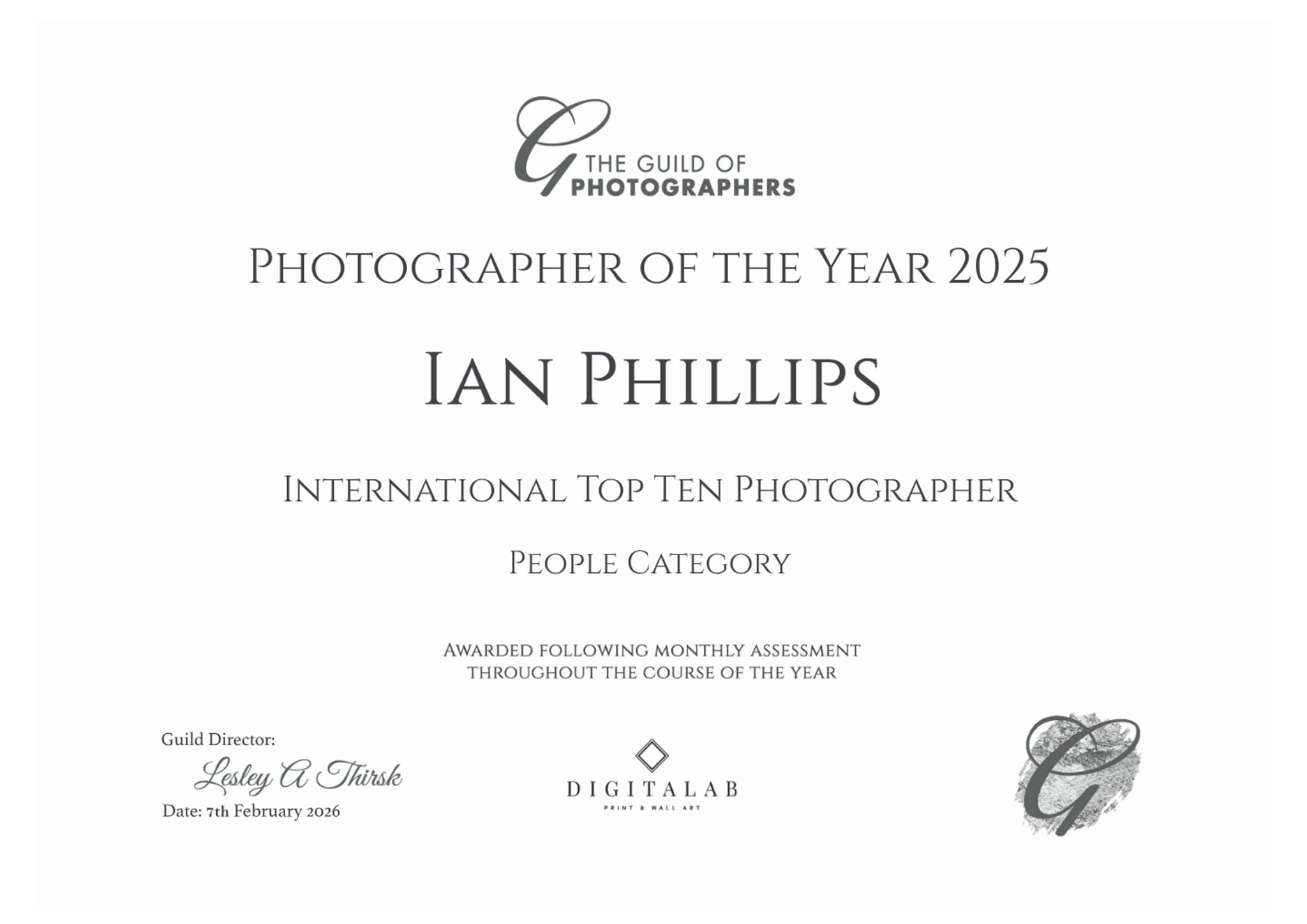
What Makes an Award-Winning Photographer? Inside Ian Phillips Photography
The phrase “award-winning photographer” appears on photography websites everywhere.
But what does it actually mean?
Is it about owning expensive equipment?
Winning a single competition?
Collecting certificates?
Creating technically perfect photographs?
Or having thousands of followers on social media?
For Ian Phillips Photography, being an award-winning photographer means something considerably broader.
It is about continually developing the craft, submitting work for independent assessment, learning from critique, gaining recognised professional qualifications and applying those lessons to every person who steps in front of the camera.
Ian’s photographic journey has taken him from military aviation and astrophotography to portraits, weddings, dance, fine art, creative photography and one of his most significant undertakings – The Heroes Project.
Along the way have come qualifications, competition recognition, publications, speaking opportunities and professional milestones.
But awards are only part of the story.
So, what really makes an award-winning photographer?
It Starts With Learning, Not Awards
Ian Phillips didn’t begin photography with the intention of collecting awards.
His original fascination was aviation.
Growing up with an interest in military aircraft and history, Ian spent time around airshows and developed a particular appreciation for the stories associated with the people and machines he was photographing.
That early photography taught him something fundamental:
A photograph can document far more than what something looks like.
It can preserve history.
It can capture emotion.
And it can tell a story.
That philosophy would become increasingly important as Ian’s photography developed.
Read the full story behind Ian Phillips Photography →
Astrophotography Changed the Direction of Ian’s Photography
During the COVID-19 lockdown, Ian began taking astrophotography increasingly seriously.
Photographing the night sky demands patience.
The photographer cannot control the weather.
Stars cannot be moved into a better position.
The Milky Way doesn’t rearrange itself because the composition isn’t quite right.
Astrophotography requires planning, technical precision and an understanding of exposure, focusing and light.
Ian began experimenting, learning and developing his technique.
His astrophotography subsequently gained publication, he began mentoring other astrophotographers and his work received wider media exposure, including BBC coverage.
Those experiences helped establish a principle that remains central to Ian Phillips Photography:
Never stop learning.
From Aircraft and Stars to People
Ian’s transition into professional portrait photography wasn’t part of a long-term business plan.
It developed unexpectedly.
In 2022, after returning to aviation photography and photographing aircraft around Bristol Airport, Ian began pointing his camera at other subjects.
Insects.
Dogs.
His children.
And eventually people.
Portrait photography changed everything.
Ian discovered that he enjoyed shaping light, experimenting with studio techniques and working directly with people.
There was also an entirely different challenge.
A landscape doesn’t become nervous when you point a camera towards it.
People do.
Portrait photography isn’t therefore only about camera technique.
It requires communication, trust and the ability to help somebody feel comfortable.
That became an increasingly important part of Ian’s approach.
What Does “Award-Winning Photographer” Actually Mean?
Photography competitions provide an opportunity for work to be examined beyond the photographer’s own opinion.
That distinction matters.
Friends may like a photograph.
Family may love it.
Social-media followers may click a heart.
But professional assessment asks different questions.
Depending upon the competition or assessment, photographs may be considered in areas such as:
- Lighting
- Composition
- Exposure
- Colour
- Tonality
- Focus
- Posing
- Expression
- Retouching
- Creativity
- Storytelling
- Technical execution
- Visual impact
Submitting work therefore involves risk.
The photographer may love an image that doesn’t perform particularly well.
Another photograph may score considerably better than expected.
Both outcomes provide information.
That is one reason Ian continues to put his photography in front of others.
Awards Should Be Evidence of Development
An award is valuable.
But the greatest long-term value may be what the photographer learns while trying to achieve it.
Professional competitions encourage photographers to look more critically at their own work.
Could the lighting have been better?
Is the composition strong enough?
Does something in the background distract from the subject?
Could the pose be improved?
Is the editing too heavy?
Does the photograph communicate anything?
Would another photographer looking at the image immediately understand what you were trying to create?
These questions gradually change the way a photographer works.
The learning begins before the shutter button is pressed.
Professional Qualifications Matter Too
Competition awards and professional qualifications aren’t the same thing.
A qualification normally involves demonstrating a consistent professional standard across a body of work rather than relying upon one successful photograph.
Ian achieved his Licentiate qualification with the Society of Wedding and Portrait Photographers (LSWPP).
In 2025, he achieved the Craftsman qualification with the Guild of Photographers.
His development continues.
Ian is working towards his Master Craftsman assessment, scheduled for December 2026.
That progression is important because it demonstrates something beyond a single award:
Continued professional development.
Discover more about Ian’s qualifications and photographic journey →
Why Independent Assessment Is Important
Photographers spend enormous amounts of time looking at their own work.
That can make objectivity difficult.
You remember the circumstances surrounding the photograph.
You know how difficult it was to create.
You remember the weather.
You remember the subject.
You know how much editing was involved.
A judge doesn’t.
They see the photograph.
That outside perspective can be extremely valuable.
Professional assessment can identify weaknesses the photographer has stopped noticing and strengths they may not have fully recognised.
The objective isn’t to change your photography every time somebody expresses an opinion.
It is to develop the ability to distinguish useful professional critique from personal preference.
Learning to Accept Criticism
This can be one of the hardest parts of creative work.
Photographers naturally become attached to their images.
A photograph may represent hours of planning and editing.
Submitting it for assessment means accepting that somebody may identify problems with it.
That isn’t failure.
It is part of development.
Ian’s approach is to use constructive criticism as information.
If several experienced photographers identify the same weakness, that is worth investigating.
If an image performs strongly, understand why.
Then apply those lessons to future photography.
This process helps transform occasional strong photographs into greater consistency.
Consistency Separates a Lucky Photograph From Professional Photography
Almost anybody can occasionally create a good photograph.
Right light.
Right moment.
Right subject.
Right circumstances.
Professional photography requires something more difficult:
Producing strong results consistently.
A wedding photographer cannot tell a couple that the lighting wasn’t ideal so unfortunately none of the photographs worked.
A portrait photographer cannot depend on every client already knowing how to pose.
A commercial photographer cannot wait indefinitely for perfect conditions.
Professional photographers need to solve problems.
They need to understand their equipment sufficiently well to adapt.
Awards and qualifications can help develop that discipline because they encourage photographers to repeatedly produce work at a high technical and creative standard.
Technical Skill Is Only Half of the Photograph
Photography is technical.
Cameras contain increasingly sophisticated autofocus systems, sensors, metering modes and processing capabilities.
But technology alone doesn’t create meaningful photographs.
A technically perfect portrait can still feel empty.
The photographer has to consider:
Who is this person?
What are we trying to communicate?
How should the light feel?
What expression works?
What should the viewer notice first?
What story are we telling?
Ian’s photography increasingly concentrates on combining technical control with human connection.
This is particularly important in portraiture.
Explore Ian Phillips Photography’s professional studio →
Understanding Light
If there is one subject that connects almost every genre Ian photographs, it is light.
Aviation taught Ian to react to rapidly changing situations.
Astrophotography taught him to find and record tiny amounts of available light.
Landscape photography developed his appreciation for natural light.
Studio photography allowed him to create and control light.
Portrait photography taught him how light changes the way a person is perceived.
Light can make a photograph:
Soft.
Dramatic.
Powerful.
Flattering.
Mysterious.
Natural.
Cinematic.
Understanding those differences is far more valuable than simply owning expensive lighting equipment.
Creativity Matters
Technical competence provides the foundation.
Creativity gives photography identity.
Ian’s portfolio now crosses a wide range of photographic disciplines, including:
- Portrait photography
- Fine-art photography
- Weddings
- Families
- Dance
- Modelling
- Cosplay
- Fantasy photography
- Pets
- Aviation
- Astrophotography
- Macro photography
- Iris photography
- Drone photography
- Commercial photography
At first glance, some of these genres appear completely unrelated.
But skills transfer between them.
Timing learned from aviation can help when photographing dance.
Patience developed through astrophotography can help with creative projects.
Studio lighting techniques influence commercial photography.
Portrait experience helps with weddings.
Macro photography encourages attention to tiny details.
Creative experimentation in one discipline can therefore influence another.
Competition Photography Encourages Experimentation
When photographers only create images they already know will work, development can slow down.
Competition work can encourage experimentation.
Try different lighting.
Change the composition.
Explore another editing technique.
Attempt something more difficult.
Create a photograph that may not appeal to everybody.
Some experiments fail.
That is useful too.
Creative development rarely happens by repeating exactly the same photograph indefinitely.
Published Photography Adds Another Form of Recognition
Ian’s work has also been published in the UK and internationally, including appearances in Digital Camera Magazine.
Publication is another useful form of external recognition because the photograph has been selected for presentation beyond the photographer’s own website or social-media channels.
Ian has also been invited to share his photographic experience as a guest speaker at The Camera Show at the NEC Birmingham.
For Ian, opportunities like these are not simply badges for a website.
They are part of a wider progression from learning photography to participating within the photographic community.
The Heroes Project: When Photography Becomes More Than Competition
Awards can recognise photographs.
Some photography achieves something different.
In 2023, Ian began The Heroes Project.
Originally created as part of a qualification project, the plan was relatively modest:
Photograph around 30 frontline uniformed workers.
The project grew.
And kept growing.
By 2026, Ian had created more than 900 individual portraits, photographing people including Second World War veterans, police officers, firefighters, paramedics, military personnel, healthcare workers and other frontline professionals.
The project has also received wider media attention, including coverage by HTV News.
But its significance to Ian goes beyond publicity.
The Heroes Project is about recognition, respect and preserving people’s stories through portraiture.
It demonstrates another important characteristic of professional photography.
Sometimes the most meaningful photograph isn’t the one with the highest competition score.
It is the photograph that matters to the person in it.
Discover Ian Phillips Photography’s Heroes photography →
Awards Mean Little Without the Client Experience
There is an important danger when discussing photography awards.
Photography can become too focused on the photographer.
Customers aren’t necessarily interested in trophies.
They want to know:
Will I feel comfortable?
Will you listen to what I want?
Will you understand what I’m trying to achieve?
Will my children relax around you?
Can you photograph somebody who hates cameras?
Will you treat me professionally?
Will I like the photographs?
Those questions matter.
Ian believes the experience of being photographed should be as important as the technical quality of the final images.
Many people feel uncomfortable in front of cameras.
Some arrive convinced that they are “not photogenic”.
The photographer’s job is not to confirm that fear.
It is to create an environment in which the person can relax.
Making People Comfortable Is a Professional Skill
There isn’t a camera setting for trust.
You cannot buy a lens that makes somebody comfortable.
Communication develops through experience.
A portrait photographer needs to recognise when somebody is nervous.
They need to explain what is happening.
Give clear direction.
Avoid making the client feel judged.
Know when to talk.
Know when to stop talking.
And recognise the moment when a genuine expression appears.
These skills are difficult to measure in a competition.
But they can make an enormous difference to the client’s experience.
Responsible Photography and Model Safety
Professional standards also extend beyond the photograph.
Ian has become particularly passionate about model safety and responsible photography.
People working with photographers should feel respected, informed and safe.
Clear communication and professional boundaries are particularly important when working with models, younger people, inexperienced subjects and anyone entering a professional studio environment for the first time.
Ian is insured and DBS checked, and his approach places communication, respect and safety at the centre of portrait and creative photography.
Professionalism is not simply demonstrated by the photograph delivered at the end.
It should be evident throughout the entire experience.
What Do Photography Awards Mean for Customers?
Customers do not need to understand photography judging systems to benefit from the process.
The value is in what professional development can contribute to the photographer they hire.
Competition, qualifications and critique encourage greater attention to:
- Lighting
- Composition
- Technical quality
- Posing
- Expression
- Colour
- Retouching
- Creativity
- Consistency
- Detail
Those skills can then be applied to everyday client photography.
Your family portrait doesn’t need to be entered into a competition.
Your professional headshot doesn’t need a trophy.
Your wedding photograph doesn’t need a judge’s score.
But you still benefit from the experience and discipline developed through producing work that is independently assessed.
Award-Winning Photography Shouldn’t Mean Every Photograph Looks the Same
A professional photographer should develop recognisable standards without forcing every client into an identical template.
People are different.
Businesses are different.
Weddings are different.
Families are different.
Creative briefs are different.
Ian’s aim is therefore not to reproduce one award-winning photograph repeatedly.
It is to apply the skills behind successful photography to the individual in front of the camera.
That may mean changing the lighting.
Changing the location.
Changing the background.
Changing the composition.
Or abandoning the original idea because something better happens during the shoot.
Why Continuing Professional Development Matters
Photography changes constantly.
Camera technology develops.
Lighting equipment evolves.
Editing software changes.
New techniques appear.
Creative styles move.
But some fundamentals remain remarkably consistent:
Light.
Composition.
Timing.
Expression.
Storytelling.
Ian continues to study, experiment and challenge his own photography because there is always something else to learn.
Achieving one qualification doesn’t mean learning stops.
Winning an award doesn’t mean the next photograph will automatically be successful.
Professional development is continuous.
That is why Ian’s progression towards his Master Craftsman assessment is important.
The objective isn’t simply another set of letters.
It provides another standard to work towards.
Is an Award-Winning Photographer Automatically the Right Photographer for You?
Not necessarily.
This is an important distinction.
Awards should form part of your decision, not the entire decision.
When choosing a photographer, look at:
- Their portfolio
- Professional qualifications
- Experience
- Reviews
- Style
- Communication
- Insurance
- Professional standards
- Specialist experience
- Whether you actually like their photography
Most importantly, speak to them.
You need a photographer whose work you like and whose approach suits you.
An impressive list of awards means little if you don’t feel comfortable working with the person behind the camera.
What Should You Look for in a Professional Photographer?
A good starting point is evidence.
Can you see genuine work?
Does the portfolio demonstrate consistency?
Is there information about the photographer?
Are qualifications explained?
Can you find customer feedback?
Does the business have an established location and contact information?
Does the photographer explain their approach?
Is there evidence of continued professional development?
These signals help potential customers make an informed decision.
Ian provides extensive information about his background, qualifications and photographic development on his About Ian Phillips Photography page.
An Award-Winning Photographer in Weston-super-Mare
Ian Phillips Photography is based in Weston-super-Mare, North Somerset, working with clients throughout Somerset, Bristol and surrounding areas.
The studio provides photography across a diverse range of disciplines, from professional portraits and headshots to family, creative, dance, model portfolio and fine-art photography.
Ian also works across weddings, commercial photography, aviation, astrophotography and specialist photographic projects.
That breadth of experience continues to influence his approach.
Every photographic discipline teaches something.
And those lessons eventually find their way back into the next photograph.
From Weston-super-Mare to Wider Recognition
Photography has taken Ian considerably further than he originally expected.
From photographing military aviation to seeing work published.
From experimenting with astrophotography to mentoring others.
From learning portrait lighting to achieving professional qualifications.
From planning 30 Heroes portraits to creating more than 900.
From entering competitions to speaking about photography at the NEC.
The individual milestones matter.
But collectively they tell a more important story:
Development.
Ian Phillips Photography today isn’t the same photography business it was several years ago.
And Ian doesn’t want it to be the same several years from now.
So, What Really Makes an Award-Winning Photographer?
It isn’t the camera.
It isn’t a certificate hanging on a wall.
And it isn’t simply being able to place the words “award-winning” on a website.
An award-winning photographer should be able to demonstrate what sits behind that description.
Learning.
Technical understanding.
Creativity.
Independent assessment.
Professional qualifications.
Consistency.
Experience.
Listening to criticism.
Respect for the people being photographed.
And the willingness to keep improving.
Awards are evidence of the journey.
They shouldn’t be the destination.
Inside Ian Phillips Photography: People Remain at the Heart of It
For all the technical equipment, qualifications, lighting and competition results, Ian’s photography increasingly comes back to one thing.
People.
The nervous person arriving for their first professional portrait.
The model developing a portfolio.
The family preserving a particular moment.
The couple trusting Ian with their wedding.
The veteran sitting for a Heroes portrait.
The business owner needing a professional image.
Every person arrives with a different story.
The camera is simply the tool used to preserve part of it.
Choose Ian Phillips Photography
If you’re looking for an award-winning photographer in Somerset or a professional photographer in Weston-super-Mare, Ian Phillips Photography offers professional, creative and personalised photography from its North Somerset base.
Ian is qualified, award-winning, insured and DBS checked, with professional recognition, publication and extensive experience across multiple photographic disciplines.
But the aim of every session remains straightforward:
Create something you’re proud of.
Make the experience enjoyable.
And keep raising the standard.
Explore Ian Phillips Photography Studio →
Discover the story behind Ian Phillips Photography →
Contact Ian Phillips Photography →
Ian Phillips Photography
Award-Winning Professional Photographer – Weston-super-Mare, North Somerset
Portraits • Fine Art • Weddings • Families • Professional Headshots • Dance • Model Portfolios • Creative Photography • Pets • Aviation • Astrophotography • Commercial Photography
Highfield House
Ebdon Road
Weston-super-Mare
North Somerset
BS22 9NY
Telephone: 07568 460157
Email: ianphillipsphoto@gmail.com
Frequently Asked Questions
What does award-winning photographer mean?
Generally, it means a photographer has received recognition for photographic work through competitions or professional assessment. Customers should look beyond the phrase itself and consider the photographer’s actual qualifications, portfolio, awards, professional experience and consistency.
What photography qualifications does Ian Phillips have?
Ian has achieved a Licentiate qualification with the Society of Wedding and Portrait Photographers (LSWPP) and achieved his Craftsman qualification with the Guild of Photographers in 2025. He is currently working towards his Master Craftsman assessment, scheduled for December 2026.
Is Ian Phillips a professional photographer in Weston-super-Mare?
Yes. Ian Phillips Photography is based at Highfield House, Ebdon Road, Weston-super-Mare, North Somerset and provides professional photography for clients across Somerset, Bristol and surrounding areas.
What types of photography does Ian Phillips specialise in?
Ian’s experience spans portrait, fine-art, wedding, family, dance, model portfolio, pet, creative, aviation, astrophotography, macro, iris, drone and commercial photography. Working across multiple genres allows techniques learned in one area to influence another.
Why do photography competitions matter to customers?
Competition and professional assessment can encourage photographers to continually examine areas such as lighting, composition, posing, expression, editing and technical execution. Customers can benefit from those skills even when their own photographs are never intended for competition.